Technology
The Internet of Things Gets a 5G Update
Source
IEEE Spectrum
Published
Source
Published
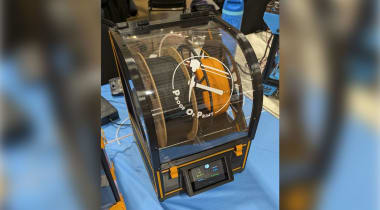
An inventor has created a filament dryer that not only dries filament for 3D printing but also mines Bitcoins, utilizing waste heat from the process. This new prototype is capable of 6 TH/s at 140W and is part of a lineup of hobbyist-focused mining devices. The filament dryer helps prevent common printing issues caused by moisture absorption and offers a proactive solution for maintaining filament quality. It is likely that this new device shares underlying technology with the inventor's previous 3D printer that also doubled as a Bitcoin miner, hinting at further scalability and innovation in this unique niche market.
Researchers at Intel Foundry have developed a breakthrough thin GaN chiplet technology that combines GaN transistors with silicon-based digital circuits to enable complex computing functions directly in power chiplets. This innovation, presented at the 2025 IEEE International Electron Devices Meeting, addresses the challenge of delivering more power, speed, and efficiency in a compact space. The ultra-thin GaN chiplet, with a base silicon measuring just 19 μm thick, incorporates the industry's first fully monolithic on-die digital control circuits. This technology offers concrete improvements in data centers, wireless infrastructure, and other industries by enabling faster switching, lower energy loss, and efficient power conversion. The use of GaN material allows for higher power density, better performance at high frequencies, and compatibility with existing silicon manufacturing infrastructure.

The whitepaper delves into the technical aspects of 5G non-terrestrial networks, focusing on satellite constellation design, radio frequency challenges, and the evolution of architecture towards unified three-dimensional networks in future generations. It explores how 3GPP Release 17 integrates non-terrestrial network support for mobile broadband and IoT services, emphasizing the importance of satellite orbit selection in determining coverage and design decisions. The paper also discusses the unique radio frequency challenges of satellite links and the adaptations needed in 5G protocols for efficient operation over satellite connections. Overall, the whitepaper aims to provide a comprehensive understanding of how non-terrestrial networks enable global connectivity in the 5G system.

Japanese firm NTT has developed a four-core multicore optical fiber (MCF) that quadruples the capacity of traditional fiber without increasing its size. This innovation is crucial for meeting the growing demand for data transfer due to advancements in 5G, AI, and cloud services. The MCF technology enables a single cable to carry four independent optical paths, significantly increasing data transmission capabilities. NTT also designed technical accessories to facilitate the integration of MCF into existing infrastructure, making upgrades more cost-effective and competitive. The technology is set to be deployed in 2029, offering a promising solution for telecom companies seeking efficient ways to enhance their networks.
We use cookies to ensure you get the best experience on our website. For more information on how we use cookies, please see our cookie policy.