Back to home
Technology

Microsoft announces 'world's most powerful' AI data center — 315-acre site to house 'hundreds of thousands' of Nvidia GPUs and enough fiber to circle the Earth 4.5 times

Source

Tom's Hardware

Published

TL;DR

AI Generated

Microsoft has revealed plans for Fairwater, a massive AI data center set to become the "world's most powerful" upon its completion in early 2026. The facility, located in Mount Pleasant, Wisconsin, will span 315 acres and house "hundreds of thousands" of Nvidia GPUs connected by enough fiber to circle the Earth 4.5 times. Fairwater will utilize closed-loop water cooling to minimize water waste and will offer ten times the performance of today's fastest supercomputer. Microsoft is focused on sustainability, aiming to avoid increasing electricity costs for local communities. The construction involves impressive numbers, including 46.6 miles of deep foundation piles and storage systems equivalent to five football fields. Multiple similar data centers are also in progress across the United States.
Read Full Article

Similar Articles

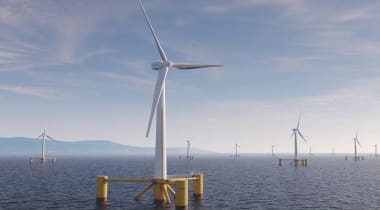
US startup plans to build data centers inside ocean-based wind turbines, servers water cooled via chilly North Sea — each leg houses a data center, firm set to launch three-legged prototype in Norway’s North Sea this year

US startup plans to build data centers inside ocean-based wind turbines, servers water cooled via chilly North Sea — each leg houses a data center, firm set to launch three-legged prototype in Norway’s North Sea this year

A San Francisco-based startup, Aikido Technologies, plans to integrate data centers into offshore wind turbines, with a prototype set to launch in Norway's North Sea by the end of 2026. The design includes a 100-kilowatt unit combining a wind turbine with an AI server to address power and space challenges faced by AI hyperscalers. Each wind turbine can potentially house a 9- to 12-MW data center, utilizing water cooling from the North Sea to manage temperatures. While challenges like inconsistent wind power and maintenance costs exist, this innovative approach could offer a solution to current land-based data center limitations.

Tom's Hardware
European AI cloud company secured tax breaks on NVIDIA AI GPUs, used them for crypto mining

European AI cloud company secured tax breaks on NVIDIA AI GPUs, used them for crypto mining

A European AI cloud company received tax breaks on NVIDIA AI GPUs and used them for crypto mining. The company took advantage of the tax incentives to mine cryptocurrency, likely Ethereum, with the powerful GPUs. This move raises questions about the intended use of the GPUs and the ethics of using tax breaks for crypto mining purposes.

TweakTown
SiPearl unveils Europe's first dual-use sovereign processor with 80 cores — expected in 2027 for government, aerospace, and defense applications

SiPearl unveils Europe's first dual-use sovereign processor with 80 cores — expected in 2027 for government, aerospace, and defense applications

SiPearl has unveiled Athena1, Europe's first dual-use processor with up to 80 cores, catering to government, aerospace, and defense applications. The CPU, based on Arm’s Neoverse V1 architecture, is set to be available in various core configurations by the second half of 2027. SiPearl's Athena1, an enhanced version of its Rhea processor, boasts advanced encryption and security features suitable for tasks like encrypted communications and intelligence analysis. The processor, manufactured by TSMC, aims to bolster Europe's technological sovereignty in the face of geopolitical challenges.

Tom's Hardware
Phison CEO claims NAND shortage could last a staggering 10 years — says memory 'supercycle' imminent and 'severe' 2026 shortages are at hand

Phison CEO claims NAND shortage could last a staggering 10 years — says memory 'supercycle' imminent and 'severe' 2026 shortages are at hand

Phison Electronics Corporation's CEO, Pua Khein-Seng, predicts a NAND flash shortage starting in 2026 that could last for a decade, surpassing other industry estimates. Pua suggests a "supercycle" in memory demand is imminent, driven by the AI data center boom. As flash demand surges due to increased storage needs for AI models, companies like SanDisk, Micron, and Western Digital are freezing or raising prices. Pua anticipates SSDs will dominate over HDDs in data centers within the next decade, with flash memory remaining strong for years to come. Morgan Stanley also foresees a "memory supercycle" ahead, influenced by HBM demand and potential market shifts.

Tom's Hardware

We use cookies

We use cookies to ensure you get the best experience on our website. For more information on how we use cookies, please see our cookie policy.